Monday, May 22, 2006

Hilulah Day: Iyar-26

Chumash
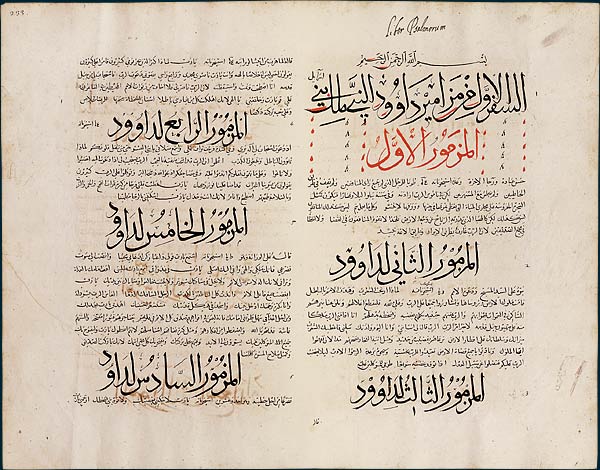
Traduction in arabic by Saadia Gaon ben Joseph (Sa'îd ibn Yûsuf al-Fayyûmî)


Hilulah Day: Iyar-26


Rabbi Saadia Gaon

Born: Al Fayyum, Egypt, 882
Died: Sura Babylonia, 942


Universal leader of Jewry, religious philosopher

Baylonia was the primary focus of Jewish learning for many centuries. The heads of the Babylonian academies of Sura and Pumbedita were called Gaonim and were widely recognized as the preeminent scholars of their day. With this distinction came the authority to promulgate religious decisions for the community. Saadia was the greatest Gaon of all times. He lived during the time that the Muslims ruled Asia Minor.In Saadia's day, he sought to reconcile the philosophical perspective of Islam, to which Jews living in Islamic countries were exposed, with the Torah.


Much of Islamic philosophy at this time was grounded in the thinking of Aristotle and Plato, and so Saadia wrote about this, as well. His most famous book is entitled Ha'Emunot Ve'hade'ot ("Faith and Belief") and it was written originally in Arabic, later translated into Hebrew by the Ibn Tibbon family.In this book, Saadia attempts to reconcile Judaism with the philosophical thinking of Aristotle and Plato, his goal being to bring assimilated Jews back to Torah and halacha. Saadia demonstrates that the teachings of the Torah will stand the test of logical inquiry. He offers unassailable proofs that the universe was created exnihilo - out of nothing, that the Creator is One, that man has a soul, that the Torah was given to the Jewish people by God on Mount Sinai, and that man has the freedom to choose between good and evil and receives reward or retribution accordingly.In addition, Saadia wrote the first Arabic translation of the Bible, which includes commentaries and grammatical notes.

He also wrote the first Hebrew dictionary, and a book about Hebrew grammar. Muslims at this time were involved in Arabic language and grammar studies and Saadia hoped to inspire Jews to explore their own religious roots more deeply.The RAMBAM (Maimonides) said of Saadia, "If not for our master Saadia Gaon, Torah would have been forgotten in Israel." Among his many books, Rabbi Saadia also wrote a commentary on Sefer Yetzirah.In Saadia's day, one of the most significant threats to Jewish life came from the Karaites, a group whose origins lay in the Jewish community, but who had separated from the Jewish community in opposition to rabbinic Judaism. The Karaites maintained that the laws of the Talmud were not obligatory upon Jews because they were written not by God, but by the rabbis.

The Karaites claimed that only the Torah comes from God and it, alone, should serve as the basis of Jewish authority and life.Traditional Judaism has always maintained that the Talmud is the Torah she'b'al peh (the Oral Torah, given at Sinai but transmitted orally for much of our history until it was finally written down in the academies of Babylonia). Saadia defended rabbinic authority against the claims of the Karaites, going so far as to declare that they were not Jews.

On Free Will...Saadia maintained that human beings possess free will, the capacity to make choices about their behavior. Muslim philosophers at this time promoted the Kallam, a system of thought which denies the existence of free will as an allusion and even denies causality of events in the universe, ascribe all power and will to Allah. Saadia parted company with Muslim philosophers over the issue of free will, for several reasons. First, if God is the first and only cause in the universe, then there is no difference between the righteous and sinners; all do the will of God. Hence there is no difference between a righteous deed and a sin. Second, if God is fully in control of people's behavior, then it makes no sense to punish one who breaks the law, since s/he is merely doing the will of God.

Finally and most importantly from a Jewish perspective, in a universe totally dominated by the will of God, mitzvot have no purpose or meaning, since people are incapable of "obeying" or "disobeying" them. There can only be a commandment if there is someone capable of accepting the commandments. In an effort to emphasize the role of free will in Jewish thinking, Saadia placed great emphasis on the covenant made at Sinai, in which the Israelites freely obligated themselves to God.Hence Saadia maintained that God created us with free will, a concept that has always been central to Jewish thinking.

May the merit of the tzaddik Rabbi Saadia Gaon protect us all, Amen.

Sunday, May 14, 2006

The Enthusiastic Pilgrim


Introduction Jerba (also spelled Djerba) is an island off the coast of southern Tunisia, the fabled home of the lotos-eaters of classical antiquity. It has an ancient Jewish community, concentrated in two villages known as Hara Kbira and Hara Sgira (the Great Quarter and the Little Quarter) which, until recently, were completely Jewish. The Muslim population of these villages is rising as more Jews join the 80,000 who have left Tunisia since the founding of the State of Israel in 1948. However, there is still an active Jewish life on the island with synagogues and schools in operation.

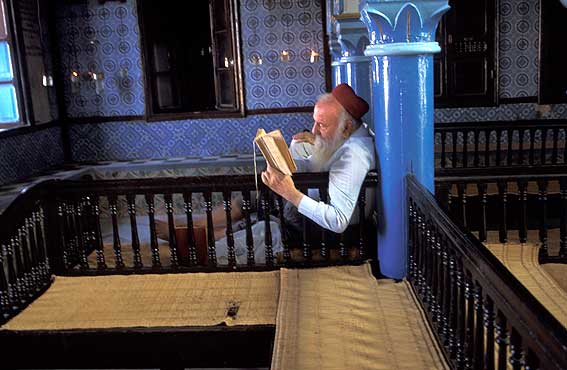
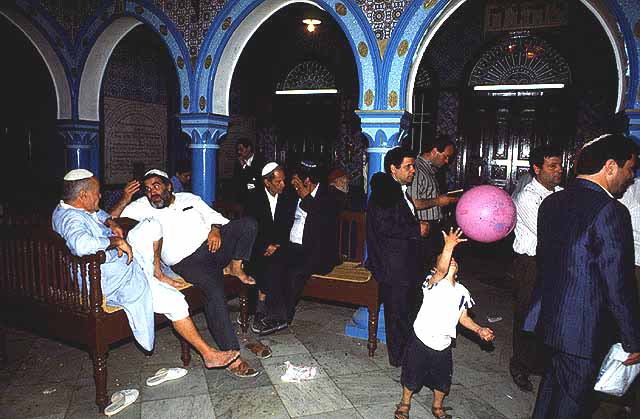
The pride of the community is the Griba ("wonderful") synagogue, located at a short distance from Hara Sgira, which was reputedly built in the time of Ezra (fifth century, B.C.E.) It is reported that Ezra visited the island, and that relics of the Temple in Jerusalem are contained within the synagogue walls. Visitors reverently remove their shoes, and in the antechamber elderly men study Jewish holy books continuously.

On the holiday of the thirty-third day of the Omer, about a month after Passover, there is a great pilgrimage to the Griba in honor of Rabbi Simeon bar Yohai, the Talmudic sage to whom the mystical book the Zohar is ascribed. This pilgrimage is still made. Hotels on the island make kosher food available, and a charter flight from Paris brings expatriates to the island airport. Like the author of the following poem, they do not wish to miss the big day.
It was here that on April 11, 2002, what at first was designated an accident took the lives of a number of German tourists. It was later declared to be an act of terror, and was widely reported in the press.

This poem was printed in a little book, undated, in Tunis. The author's name, David, appears in the last stanza. It is a touching monument to simple and ecstatic religious faith. After a pious messianic hope, he describes the joy of pilgrimage, the certainty of the acceptance of any petition made on such an occasion, and then proceeds to mention the various places in Libya and southern Tunisia from which the pilgrims, filled with spiritual intentions, come. Sfax and Tripoli perhaps now have a couple of hundred Jews each. Gabes has a few dozen. Medenine and Ben-Gardane, two small towns on the mainland opposite Jerba, have none at all. Sic transit.

In Praise of the Griba

Until when shall we hope for him?
The Messiah has not come.
The Lord will bring him.
You never know when.

Listen brothers,Men and women,How precious is this place!
There is nowhere like it.
How tremendous is this spot!
Happy the one in whomLight dwells,
and his starRises among the twelve.

Place precious and exalted!
Sanctuary of God most High,
Visiting it is sweet to me,
No year will I forget.
Whoever has a request.
Far or nearMakes for the Griba.

He does not miss his goal.
When people in trouble.
Who experience grief.
Make for this pilgrimage,
Their ills fly away.

Joy comes to them,
Every moment, every step.
Their brightness is splendid,
And their light does not go out.
They come hereWith pure intent.
Every design is fulfilled,No injury remains.

Every design is accomplished.
For him who knows its worth.
Even the barren woman.
Through God brings forth a dozen.
Our Lord will make good the loss.
Of him who visits with full heart,A
nd grant his request.
When he comes to the sanctuary.

The place glows.
With burning lamps,
And he who comes to the festivity,
Spreads frankincense.

Poems and worship,
Reading and repetition.
The feast will not cease,Never will it perish.

Pray at the Ark –
You will get everything!
Money will be without counting,
It will be as nothing.
Our brothers from Tripoli,
Likewise from Gabes
–Their pilgrimage is acceptable,
Their presence well received.

The pilgrims from Sfax
–Not one of them falls short,
Guileless they are,In private as in public.
May the Merciful One have mercy,
On the pilgrims from Medenine,
For long yearsAnd yet more.

The pilgrims from Ben-Gardane,
From the provinces and towns
–The Lord of the festivity,
Will bring them soundness of body.
Today is a happy day.
Every year there is a holiday
–I, David, your servantWill not forgo your company!

Wednesday, May 10, 2006

Hilulah Day: Iyar-10


Eli Kohen Gadol

Born: Eretz Yisrael, 988 BCE.

Died: Eretz Yisrael, Shiloh, 890 BCE.


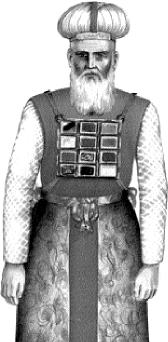
Eli served as Kohen Gadol (high priest) and judged the nation of Israel for 40 years (Samuel I 4:18), during the period of the Judges in Israel.

He was one of the descendants of Ithamar son of Aharon HaKohen (Yalkut Shimoni, Shoftim 68).

He was king [leader of Israel], Kohen Gadol (high Priest), and head of the Sanhedrin (Yalkut HaMechiri, Tehillim 75:4).

The Book of Tagin was copied by Eli from the 12 rocks that Yehoshua (Joshua) erected in Gilgal, and [Eli in turn] transmitted it to the prophet Shmuel (Samuel) (Otzar HaMidrashim 564).

Channah [who had been praying silently in Eli's presence] answered and said, "No my master (Samuel I 1:15). You are not a master in this matter, and Divine Inspiration does not rest upon you if you have judged me unfavorably [thinking that I am intoxicated]" (Berachot 31b).

Eli aged [prematurely] because of the troubles he had with his sons Chofni and Pinchas (Aggadat Bereishit).

Before Eli's sun set, the sun of Shmuel (Samuel the prophet) the Ramathite rose (Kiddushim 72b).

Eli died on the tenth of Iyar (end of Megillat Ta'anit).

When Eli died, Shiloh was destroyed and [the Sanctuary was relocated] to Nob (Zevachim 118b).

The house of Eli has no sages ordained [to render halachic rulings], for [God told Eli,] "There shall be no sage in your house" (Samuel I 2:32) (Sanhedrin 14a).

The iniquity of the house of Eli shall not be expiated with sacrifice or offering (Samuel I 3:14). With sacrifice or offering it is not expiated [for their iniquity dealt with the sacrifices (Metzdat David)], but it is expiated with Torah study and with seeds of kindness (Rosh Hashanah 18a).

There was one family in Jerusalem whose [members] used to die at the age of 18. They were of the house of Eli, [whom God had told,] "All the increase of your house will die young men" (Samuel I 2:33).

May the merit of the tzaddik Eli Kohen Gadol protect us all, Amen.

Free Hit Counters

hit Counter

Friday, April 28, 2006

Hilulah Day: Nisan-30

(the blue strings are "Kedusha- Kever" strings wrapped around the site)


Rabbi Chaim Vital

Born: Tzefat, Eretz Yisrael, 1543

Died: Damascus, Syria, 1620

Rabbi Chaim Vital was the closest disciple of the great 16th-century kabbalist, the Ari - Rabbi Itzchak Luria.


Rabbi Chaim Vital learned nigleh, the revealed aspects of the Torah, under the tzaddik Rabbi Moshe Alshich, who was also the one to ordain (semicha) him as a rabbi.

The Ari's teachings were all given orally, and he himself wrote very little in print. His faithful disciple, Rabbi Chaim Vital, recorded his master's teachings in several books which have come down to us, generally known by the name Kitvei HaAri. Along with the Zohar, these books are considered to be the major source for kabbalistic study.

Rabbi Chaim Vital studied with The Ari for a period of less than two years (both men were in their 30's !), until The Ari left the world. Yet the knowledge passed unto Rabbi Chaim Vital is vast and encompassing.

The Ari claimed that the soul of Rabbi Chaim Vital, was a very high soul, from the same root of soul of Rabbi Akiva and King Chizkiyahu , both the father (Rabbi Yosef Vital) and son (Rabbi Shmuel Vital) of Rabbi Chaim Vital were sparks of soul of the great Tana, rabbi Meir Baal HaNess. His son Rabbi Shmuel Vital was the one who put the finishing touches on the Eight Gates of Kitvei HaAri, and published them. Some other manuscripts (mainly Etz Chaim), Rabbi Chaim Vital wished not to published and took it to the grave with him.


Years later Rabbi Avraham Azulai and Rabbi Yaakov Tzemach dealt with Yichudim (special Kabbalistic meditations) and She'alot Chalom (dream meditation) until permission was granted to them by Rabbi Chaim Vital in a dream to dig at his gravesite and excavate those additional writings.

Rabbi Chayim Vital on the ARI...

" The Ari overflowed with Torah. He was thoroughly expert in Tanach, Mishnah, Talmud, Pilpul, Midrash, Agadah, Ma'aseh Bereshit and Ma'aseh Merkavah. He was expert in the language of trees, the language of birds, and the speech of angels. He could read faces in the manner outlined in the Zohar (2:74b). He could discern all that any individual had done, and could see what they would do in the future. He could read people's thoughts, often before the thought even entered their mind. He knew future events, was aware of everything happening here on earth, and what was decreed in heaven. He knew the mysteries of gilgul [Reincarnation], who had been born previously, and who was here for the first time. He could look at a person and tell him how he was connected to the Supernal Man, and how he was related to Adam. He could read wondrous things [about people] in the light of a candle or in the flame of a fire. With his eyes he gazed and was able to see the souls of the righteous, both those who had died recently and those who had lived in ancient times. With these he studied the true mysteries. By a person's scent he was able to know all that he had done, an ability that the Zohar attributes to the holy Yenuka [Child] (3:188a). It was as if all these mysteries were lying in his bosom, waiting to be activated whenever he desired. He did not have to mitboded [seclude himself] to seek them out. All this we saw with our own eyes. These are not things that we heard from others. They were wondrous things that had not been seen on earth since the time of Rabbi Shimon bar Yochai. None of this was attained through magic, heaven forbid. There is a strong prohibition against these arts. Instead, it came automatically, as a result of his saintliness and asceticism, after many years of study in both the ancient and the newer Kabbalistic texts. He then increased his piety, asceticism, purity and holiness until he reached a level where Eliyahu HaNavie (Elijah the prophet) would constantly reveal himself to him, speaking to him "mouth to mouth," teaching him these mysteries. "
________________

Rabbi Chaim Vital wrote Sha’arei Kedusha (Gates of Holiness) as a guide to achieving ruach ha-kodesh (divine inspiration) and nevuah (prophecy). The text (in its forth chapter) even teaches how to use the holy 72 names. Yet, the largest portion of the book is dedicated to the preparations for these holy acts. The lion’s share of this material is musar (ethics), teaching us how to rectify and elevate our midot (personalities). It is these teachings that have made Sha’arei Kedusha a classic in the yeshiva world. That forth chapter of Sha’arei Kedusha and other kabbalistic works attributed to Rabbi Chaim Vital, were published under the title Ktavim Chadashim L'Rabbi Chaim Vital (Hebrew), and Otzrot Chaim

May the merit of the tzaddik Rabbi Chaim Vital protect us all, Amen.

Google PR™ - Post your Page Rank with MyGooglePageRank.com

Hilulah Day: Nisan-30

Rabbi Yosef HaLevi Ibn Migash

Born: Seville, Spain, 1077

Died: Lucena, Spain 1141

Talmudist, Teacher.

At a tender age, R' Yosef displayed great talents and sharp wit. Rabbi Yitzchak Albaliah predicted that the child would become a great luminary in the Torah world and implored Yosef's father to provide him with outstanding teachers and to dedicate all of the youth's time to learning.

At the age of 12, R' Yosef traveled to Lucena, to continue his studies. Raabi Yitzchak Alfasi's (Rif) praise of R' Yosef was unbounded, and although his own son R' Yaakov was an eminent sage, Rif designated the youthful R' Yosef to be his successor.

As head of the famous academy of Lucena, R' Yosef taught numerous disciples including Rabbi Maimon, father of Rambam. Rambam's praise of R' Yosef in uncharacteristically ecstatic. "The depth and scope of his wisdom astound all who study his words" said the Rambam. Having absorbed R' Yosef's teachings from his father, Rambam refers to R' Yosef as "my teacher".

Rabbi Yosef also replied to halachic inquiries sent to him from all the Sephardic communities, and his sharp intellect was apparent in correspondence as well as in his discourses. A small portion of his extensive responsa has been published under the title Sheilot U'Teshuvot HaRi Migash. Rabbi Yosef composed commentaries to many Talmudic tractates, of which only those to Bava Batra and Shevuot have been published.

May the merit of the tzaddik Rabbi Yosef HaLevi Ibn Migash protect us all, Amen.

Tuesday, April 25, 2006

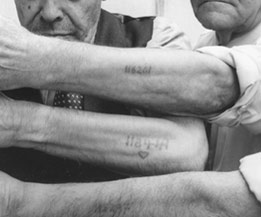
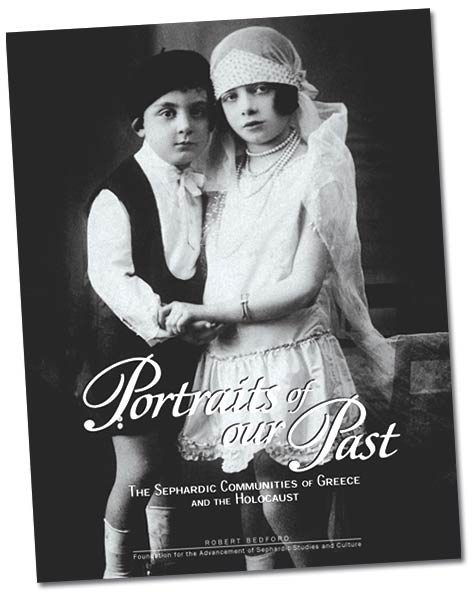
Holocaust Survivors from Salonica

Holocaust Survivors from Salonica


A poem by Yitzhak Katznelson, which was written a few days before the Germans killed him, and it seems to be appropriate even today.

Sure enough, the nations did not interfere, nor did they protest,Nor shake their heads, nor did they warn the murderers.Never a murmur. It was as if the leaders of the nationsWere afraid that the killings might stop.

The House by the Sea: A Portrait of the Holocaust in Greece.


There are far too few books in English on the Sephardic experience in the Holocaust. There would be fewer still if it weren't for Rebecca Camhi Fromer, author of the groundbreaking The Holocaust Odyssey of Daniel Bennahmias, Sonderkommando (University of Alabama Press, 1993) and co-author, with Rene Molho, of They Say Diamonds Don't Burn (Judah Magnes Museum, 1994). In her latest book, The House by the Sea, she weaves the facts of the Holocaust in Greece around the personal story of Salonica native Elias Aelion. Elias is not a Holocaust survivor in the usual sense, for he was never in a German concentration camp. There are no descriptions here of concentration camps, mass murders, or crematoria. Yet the book is subtitled "A Portrait of the Holocaust in Greece" because, as the author says in the Preface, this is "a serious work that is grounded in the past, the tenor of the struggle to survive, and the nature of the loss in Greece due to the Holocaust."


Elias Aelion was born in the house at the edge of the sea, a house which remains associated in his memory with "all that seemed worthwhile, warm and loving, simple and natural" His grandparents lived there, and it was the focal location of the very large family's life, of gatherings on Sabbaths, holidays and special occasions, of games and fights with cousins, and of other mundane events of a normal life. Elias was inducted into the Greek army in 1939, becoming part of the defense army against the invading Italians in 1940. When the Germans invaded in April, 1941, the Greek soldiers fled in disarray, and Elias escaped on foot with his comrades, walking for about 300 miles from somewhere between Bulgaria and Yugoslavia into Greece. When his family and friends and all the other Jews of his hometown went on the infamous "transports", he was in Italian-occupied Athens. Returning to Salonica, he finds his community and family gone.

Besides lending her own poetic eloquence to Elias's language (the story is told in the first person by Elias), Ms. Fromer also speaks to readers directly in the Introduction, the notes, the Appendices and the Afterword, in order to to create a complete picture of the events. In the Introduction, she presents a general historical background of the Jews of Greece, the culture of the Jews of Salonica (the city that "was a main center of Sephardic life, not a mere outpost of Jewish survival"), and the destruction of their great culture within a period of less than five months, culminating with the nineteenth and last transport out of Salonica on August 18, 1943. Alongside Elias's story, Ms. Fromer adds illuminating and interesting side notes. (One of the notes, however, gives the wrong information on the origin of the term "sefer tasin" - a portable food pot. The term has nothing to do with the Hebrew "sefer", meaning book, as is indicated, but comes from "sefer tasi" in Turkish - "sefer" meaning journey or expedition, related to the English word "safari".) The Ladino proverbs (with English translations) that introduce each chapter are not only appropriate preludes to the upcoming themes, but also hint at the richness of the language and the philosophy of life of the Sephardim obliterated in the Holocaust.

The Appendices include a historical time-line, a chronology of the Holocaust in Greece, a map, and archival information on the transports. One of the documents, from the O.S.S. (Office of Strategic Services), declassified only in January of 1998 and published here for the first time, dispels any doubt that at least by 1943, the Allies had clear information about the planned extermination of the Jews of Europe.

The House by the Sea is an engagingly-told piece of little-known history, and an intimate look at the destruction of a great and vibrant Sephardic culture. If we are to understand the full scope of the Holocaust, this history must be known, and that culture must be understood.


International Sephardic Leadership Council (ISLC) calls on the United States Holocaust Memorial Museum (USHMM) to explain why they decline to address the historically documented collaboration between Arabs and Nazis during the Holocaust, and how that collaboration has influenced present anti-Semitism in Islamic countries.

FOR IMMEDIATE RELEASE

(New York, NY) April 25, 2006 - On the occasion of Yom Hashoah, the Holocaust Martyrs' and Heroes' Remembrance Day, the International Sephardic Leadership Council (ISLC) calls on the United States Holocaust Memorial Museum (USHMM) to explain why they decline to address the historically documented collaboration between Arabs and Nazis during the Holocaust, and how that collaboration has influenced present anti-Semitism in Islamic countries.

The USHMM, a federally funded government institute, has never presented an exhibit or sponsored an event confronting Arab or Muslim anti-Semitism or the fate of Jews in Arab countries during the Holocaust. These countries include Jews from Morocco, Algeria, Tunisia, Libya, Egypt, Iraq and other countries effected during and immediately after the war years, because of Nazi inspired Arab anti-Semitism.

Historically, it is well documented and established that Muslim leaders worked hand-in-hand with Nazi leaders during World War II, and the intensifying hatred of Jews in the Middle East today is a result of those relationships. Amid almost daily pledges from Iran to “annihilate” Israel, the USHMM remains silent about the historic cause of the exacerbation of Muslim anti-Semitism.

Shelomo Alfassa, executive director of the ISLC commented,“When a public official of the USHMM publicly minimizes and obscures, even denies, well-settled historical facts regarding the extensive relationship between the Grand Mufti and Holocaust-era Arabs with the Third Reich, you know there is a failure in the system.” This statement was issued in response to the Chief Historian of the USHMM declaring, “There was no collaboration between the Arabs and the Nazis.” In response to this, the International Sephardic Leadership Council filed a formal complaint with the USHMM Auditor General and called for investigation. To this day, the Museum has not responded.

U.S. Congressman Eliot Engel (D-NY) joined the International Sephardic Leadership Council at a January 2006 town hall meeting in Washington D.C., where he commented, “The Museum should better understand and underscore the Nazi hatred of Jews and contemporary anti-Semitism in the Muslim world which is the natural inheritance of Hitler’s beliefs.” Carol Greenwald (of Holocaust Museum Watch) and Chuck Morse (candidate R-MA) issued an op/ed in The Washington Times saying, “The U.S. Holocaust Memorial Museum should be an authoritative voice educating the museum's visitors and the public about the re-emergence of genocidal hatred as a political tool. The museum's mission requires it to publicize this rebirth of Nazi propaganda though exhibits and educational programs."

The former director of the USHMM agrees. Dr. Walter Reich told a major Israeli newspaper, “There is no doubt that most expressions of anti-Semitism today, and the main basis for Holocaust denial, are in the Arab-Muslim world.” Reich stated he believed it reasonable for the USHMM to take seriously the expansion and increased power of anti-Semitism and Holocaust-denial in the Arab world.

Despite the fact that the USHMM has exhibits on significant issues such as propaganda, genocide in Darfur and Rwanda, and persecution of homosexuals; it makes no mention of Arab anti-Semitism—not of its history in the last century—not of its current existence. While Yad Vashem, Israel's Holocaust Museum, is discussing the German-Arab ties, and while Encyclopedia of the Holocaust devotes more space to the Mufti of Jerusalem than to any other Nazi leader except Hitler, the USHMM is covering its eyes and ears unashamedly ignoring historical facts.

Editor's note: This history of this subject has been made available in a 25 page document issued by the ISLC: "A Backgrounder of the Nazi Activities in North Africa and the Middle East During the Era of the Holocaust" at www.sephardiccouncil.org.

The International Sephardic Leadership Council is based in the heart of the vibrant Near-Eastern Sephardic Community of New York City, a community highly committed to Judaism, made up of 75,000 Syrian, Egyptian, Lebanese, Turkish and North African Jews; one of the largest, strongest, and fastest growing Sephardic communities in the world.

Monday, April 24, 2006

Hilulah Nisan-26 Yehoshua (Joshua) Ben-Nun

Kever Yehoshua (Joshua) Ben-Nun


Yehoshua (Joshua) Ben-Nun

Born: Egypt, 1354 BCE.

Died: Eretz Yisrael, 1244 BCE.

Yehoshua married Rachav, who gave shelter to the two spies (Yehoshua 1). In Shaar HaGilgulim (hakdama 36) the Ari, Rabbi Yitzchak Luria says that Rachav was a very holy soul and it wasn't in vain that Yehoshua married her.

The face of Moshe (Moses) was like the sun, the face of Yehoshua like the moon (Bava Batra 75a).

Yehoshua did not call himself a servant of God, but the Holy One, Blessed is He, called him that (Sifri Va'etchanan 27).

Three were crowned with the titles of "age" and "days," and all three were heads of distinguished houses, Avraham, Yehoshua, and David. Avraham was the head of the Patriarchs, Yehoshua the head of the Kingship of the Tribe of Ephraim, and David the head of the Kingship of the Tribe of Yehudah (Bereishit Rabbah 59:6).

His coin had an ox on one side and a re'em, an animal with majestic horns, on the other (Yalkut Shimoni, Yehoshua 17).

When Hashem told Moshe whom to choose as the next leader, he said to him, "Take yourself Yehoshua son of Nun (Numbers 28:18) who is a hero like yourself" (Sifri Vayeilech 305).

The poor man uses entreaties (Proverbs 18:23) refers to Moshe who did not enter the Holy Land. But the rich man answers impudently (ibid.) refers to Yehoshua who entered and said, "Would that we had been content and dwelt beyond the Jordan (Joshua 7:7), and not entered the Land of Israel!" He said this when thirty-six Jews fell in the battle of Ai (Sanhedrin 44a).

Calev son of Yephuneh the Kenizite and Yehoshua son of Nun were equal to one another (Tosefta, end of Kritut).

When Yehoshua left the camp of Israel to wait at the bottom of Mount Sinai for the return of Moshe, manna fell for Yehoshua just as it fell for the whole community of Israel (Yoma 76a).

Manna fell on his limbs, and he would take it and eat it (Mechilta Beshalach 4:3).

Yehoshua led Israel for twenty-eight years (Seder Olam Rabbah 12).

Yehoshua was five cubits tall. On his head sat a royal crown inscribed with God's Name (Otzar HaMidrashim 210).

Yehoshua circumcised the people of Israel in Egypt, as it is written, Hashem said to Yehoshua, "Return and circumcise the Children of Israel a second time" (Joshua 5:2) (Shemot Rabbah 19:5).

Moshe received the Torah from Sinai and transmitted it to Yehoshua, and Yehoshua to the Elders (Avot 1:1).

He engaged in Torah study from childhood to old age (Tanna d'Bei Eliyahu Zuta 13).

Yehoshua was elevated only because he occupied himself with Torah study continuously (Mishnat Rabbi Eliezer13).

Yehoshua sat and expounded, and everyone knew that he was expounding the teachings of Moshe (Yerushalmi Shekalim 2:5).

Even in matters that he had not heard from Moshe, his own reasoning corresponded with what had been told to Moshe at Sinai (Yerushalmi Pe'ah 1:1).

Seeing how precious the words of Torah were to Yehoshua, the Holy One, Blessed is He, said to him, 'This Book of the Torah will not leave your mouth" (Joshua 1:8) (Menachot 99b).

He made himself like a fool before our teacher Moshe, whom he troubled to teach him Torah every minute until he had learned the entire Torah (Midrash HaGadol, end of Devarim).

Yehoshua wrote these words in the book of the Law of God (Joshua 24:26).

Yehoshua wrote in his Book words concerning the cities of refuge, see Joshua 20, that are written in the Torah (Makkot 11a).

Moshe the servant of Hashem died there (Deuteronomy 34:5).

Moses wrote the whole Torah up to that verse. The rest was written by Yehoshua son of Nun (Menachot 30a).

Yehoshua wrote his book (i.e., the Book of Yehoshua) and the last eight verses of the Torah, Pinchas the Kohen Gadol completed the Book of Yehoshua (Bava Batra 14b).

Yehoshua was fluent in the book of Deuteronomy (Devarim), which he studied constantly. When the Holy One, Blessed is He, appeared to him, He found him sitting with the book of Deuteronomy in his hand and said to him, "Strengthen yourself, Yehoshua, persevere, Yehoshua. This book of the Torah will not leave your mouth" (Joshua 1:8).

Yehoshua took the Book of Deuteronomy, displayed it to the sun, and said, "Because I have never ceased studying this book, you should cease your movement at my request" (Bereishit Rabbah 6:9).

If someone asks, "Why did Yehoshua build an altar on Mount Eval? Was there no Tabernacle?" answer him that the Holy One, Blessed is He, said, "It is I who told him to do so" (Bamidbar Rabbah 14:1).

When our teacher Moshe was about to depart for Paradise, he said to Yehoshua, "Ask me all the questions that you have." "My teacher," replied Yehoshua, "did I ever leave you for a short time and go elsewhere? Did you not write of me, He does not leave the tent (Exodus 33:11)?"

Immediately Yehoshua's intellectual powers were weakened so that he forgot 300 laws and had 700 uncertainties. All the Israelites rose to kill him. The Holy One, Blessed is He, said to him, "To tell you what you do not know is impossible. Go and distract them with war to capture the Land of Canaan" (Temurah 16a).

Three thousand laws were forgotten in the period of mourning for Moshe. The people said to Yehoshua, "Ask God." He replied, "It is not in the heavens" (ibid.).That night Yehoshua went into the valley (Joshua 8:13).

He went into the depth of Halachah (Eiruvin 63b).

The Death of Yehoshua

Yehoshua did not rebuke Israel until he was near death (Sifri Devarim 2).

It is written, "As I God was with Moshe, so will I be with you" (Joshua 1:5).

Yehoshua should therefore have lived for 120 years like our teacher Moses. Why were ten years deducted from his life? At the time the Holy One, Blessed is He, said to Moshe, "Avenge the Children of Israel of the Midianites, afterward you will be gathered to your people" (Numbers 31:2).

Although he was told he would die, he did not delay, but acted quickly: And Moshe send them (ibid. v. 6). But when Yehoshua came to fight the thirty-one Kings of Canaan, he said, "If I slay them immediately, I will die immediately, just as Moses did." What did Joshua do? He began to delay the wars against them. The Holy One, Blessed is He, said to him, "Since you have done that, I will shorten your life by ten years" (Bamidbar Rabbah 22:6).

He died only because of the counsel of the serpent (i.e., the sin of Adam and Eve) (Zohar 2:194b).

Before the sun of Yehoshua set, the sun of Othniel son of Kenaz had arisen (Bereishit Rabbah 58:2).

When Yehoshua was born, no one took note, when he died, all of Israel took note. However, the Israelites were lax in doing kindness with Yehoshua son of Nun by mourning him properly. One was busy with his vineyard, the other with his field, yet another with his coal. The Holy One, Blessed is He, therefore sought to make the whole world quake, as it is written, They buried him, north of the Mount of Eruption (Joshua 24:30) (Midrash Shmuel, ed. Buber, 23:7).

May the merit of the tzaddik Yehoshua Ben-Nun protect us all, Amen.

Saturday, April 22, 2006

The Lisbon Massacre


The Lisbon Massacre

----- Original Message -----

From: Richard Zimler Subject: The Lisbon Massacre

Dear Rufina, Hi! I hope all is well in South Africa! We will have a ceremony to commemorate the Massacre on April 29th in Lisbon. I wrote the attached article for the event. Feel free to circulate it to your e-mail list or put it on your wite... (Or not - I don't know if people will be interested). Love, Richard.

The 500th Anniversary of the Lisbon Massacre

By Richard Zimler

Precisely 500 year ago, on April 19, 1506, the Lisbon Massacre began.

At the time, the Portuguese capital was a dusty, disease-ridden city wasted by plague and drought. Just off the main square, in St. Dominic's Church, priests decided to restore the demoralized residents' faith in God's mercy. That morning, they apparently carved a niche at the back of a large crucifix. During mass, they put a candle inside so that the glow of the flame would show through, declaring the radiance a miracle.

As the story goes, among the worshipers was a man who called out that rain would be a far more useful miracle. This daring but foolhardy churchgoer happened to be a New Christian - a Jewish convert to Roman Catholicism. Thousands of New Christians lived in Lisbon at the time because King Manuel had ordered all of the Portuguese Jews forcibly converted to Christianity nine years earlier. Their only other choice had been death.

The worshiper who was foolish enough to criticize the priestly ruse in St. Dominic's Church that day was immediately seized, and outraged members of the congregation soon chopped off his head. Furious Dominican priests subsequently led a mob out to the streets, inciting them to riot with calls for "Death to the Jews and heretics!"

Most of the former Jews had moved their faith into the shadows by then; in public, they professed to be good Catholics, but in their own homes - behind closed curtains and locked doors - they practiced their traditional religion. On the 19th of April, most of them would have been celebrating Passover.

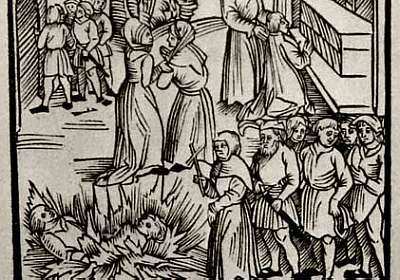
As the crazed crowd rampaged through the traditional Jewish quarters of the city, they burst into New Christian homes and murdered whomever they could capture. Over the course of three days of rioting, they dragged the victims' bodies to the Rossio, the square that is still at the heart of the Portuguese capital, and burnt them in two enormous pyres.

Contemporaneous accounts tell us that "Northern sailors" paid for the wood to burn the bodies. They do not mention the stench of charring human flesh, but I'd imagine that no one in Lisbon that day would ever forget it.

Some historians give the death toll as high as four thousand, though most estimates center around a figure of 2,000. In any case, given that the Jewish population of the city could probably not have been more than 10,000, virtually every Jewish family would have lost a loved one that day.

I first read about the Lisbon Massacre in 1989, by which time I'd been to Portugal several times to visit friends, and it shocked me that none of them knew anything about the pogrom. I soon discovered, too, that it wasn't mentioned in school textbooks. The massacre had been erased from collective memory. It was as if the 2,000 Jews who'd been murdered in April of 1506 had never lived.

Feeling outraged, I decided to make the Lisbon Massacre the background for the novel I was then planning about a 16th Century Portuguese artist. This tragic event fit perfectly into my objectives as a writer, since one of my aims has always been to give voice to people who have been systematically silenced. I take pride in crafting stories that force us to remember events that many people would prefer to forget.

The novel I was then planning turned into The Last Kabbalist of Lisbon, which tells the story of Berekiah Zarco, a bright and studious young New Christian who lives through the Lisbon Massacre only to discover that his beloved Uncle Abraham, his spiritual mentor, has been murdered in the family cellar. Berekiah must track down the killer. As a kabbalist interested in the symbolic meaning of events, he also tries to interpret what the pogrom means for him, his family, the Jewish people, all of humanity, and even God's Upper Realms. Berekiah gives his interpretation on the last page of the novel, and it is a reading of events that gives the previous 300 pages of the book a poignant and chilling new meaning.

In my subsequent novels, Hunting Midnight and Guardian of the Dawn, I've written about other dramatic and little-known events in Sephardic Jewish history, including the imposition of the Inquisition in Goa, India. Indeed, my aim has been to create a Sephardic Cycle, a series of independent novels - to be read in any order - about different branches and generations of Berekiah Zarco's family.

A few months ago, after I reminded one of Portugal's Jewish leaders about the upcoming 500th anniversary of the massacre, the Lisbon Jewish community decided to hold a commemoration ceremony on April 29th. As that date approaches, I've been thinking about why we ought to remember the 2,000 Jews murdered five centuries ago.

For anyone who believes that we learn from history, the answer is obvious: we should commemorate the massacre in order to prevent such murderous outbreaks of religious and ethnic hatred from happening again. For practicing Jews, another reason is provided by Judaism's extraordinary emphasis on remembrance. Every Passover, for instance, we re-enact the Hebrews flight from Egypt to the Promised Land. We do this, I think, not just to feel ourselves linked to our forefathers and bound to God, but also to remind ourselves that we are exactly like the people who have come before us.

Although both of these reasons once seemed entirely valid to me, I now have my doubts. Having recently turned 50, and no longer as optimistic as I was as a young man, I've come to believe that only a fraction of us learn anything valuable from history. And I've lately begun to suspect, too, that in remembering our forefathers - in feeling ourselves part of a tightly knit Jewish community - we may tend to exclude people of other ethnicities and religions, even when it comes time to help them fight against violent oppression.

It's when I open my morning newspaper and read about yet one more bombing in Iraq and more attacks in Israel and Palestine - just to choose two obvious examples - that I become convinced that we are largely deaf to the voices of our ancestors. And even those people who do speak of having learned from the past often seem to have picked up the wrong lessons. America's leaders are convinced, for instance, that the September 11th terrorist attacks justify their country using any means necessary to achieve current foreign policy goals. And many American pundits somehow learned from their nation's history of foreign warfare that U.S. troops would be met with open arms in Iraq.

All over the world - but especially in the Middle East - perpetrators of violence point to their people's past sufferings as justification for committing moral outrages.

Yet even though I am riddled with doubts about our ability to make use of the past to create a better future, I still very much want to commemorate the death of 2,000 Jews in Lisbon. A few days ago, I had a seemingly silly daydream that gave me the reason why.

As I was sitting at my desk in my Porto home, I imagined a spaceship from a planet 100 light years away landing nearby, and when our extraterrestrial visitor came down his ramp, I decided to ask him about the history of his people and planet. But he knew almost nothing.

To me, that seemed a waste of a wonderful opportunity. To have journeyed for many decades, across an unimaginable expanse of space, and then have nothing to tell us about what his world has gone through. Why come to Earth at all?

My brief daydream left me feeling that those of us without wide and varied historical knowledge have something essential missing from our lives. How is it possible to go on the wonderful journey we each make - from birth to death - without knowing the triumphs and miseries of centuries gone by, without knowing where we have been?

Our history is what any visitors to our planet would want to know first, and they'd be right! Because it helps to make us who we are. The more we know about where we've come from, the greater our insight will be into ourselves, our loved ones, our countries and our world.

I believe now that Jewish tradition, in re-enacting historical events, points us in the exactly the right direction; past struggles and trials prove to us that we are all on the same journey, and if we are to have any hope at all of rectifying injustices in our world, I believe that we need to be reminded of that as often as possible. But I'd also like to expand the scope of our Jewish celebrations. Though it might seem absurd to some, I think it's essential that we remember the tragedies and triumphs of other peoples - of Sudanese, Rwandans, Afghanis, and everyone else. In part, that's because - as heretical as it may sound to Orthodox Jewish ears - I believe that all human beings are God's Chosen People. In other words, an African slave shot down by an American plantation owner while fleeing captivity is as much my ancestor - and as worthy of my remembrance - as a Hebrew slave fleeing Egypt 2,500 years ago.

So I'll be in Lisbon on April 29th, thinking not only about the Jews massacred in April of 1506, but also about everyone still being crushed and murdered on behalf of fundamentalist gods, dictators, and political ideals.

Richard Zimler is a novelist living in Porto, Portugal. The books that make up his Sephardic Cycle are The Last Kabbalist of Lisbon, Hunting Midnight, and Guardian of the Dawn.

Friday, April 21, 2006

Remembering the Slaughter of our Portuguese-Jewish Ancestors


Remembering the Slaughter of our Portuguese-Jewish Ancestors : 19th - 21st April, 1506

Querido Irmaos e Irmas of Saudades-Sefarad

Thank you Laura for posting Nuno's site: www.ruadajudiaria.com ... and thank you Sergio Mota for your beautiful tribute in remembrance of this sad & tragic period of our history. I appreciate the forum so very much and in spite of not being able to participate always look forward to the many interesting and enriching posts.

I feel very strongly about this time in history and hope you will all be supportive by honoring our (Portuguese-Jewish) martyrs of 19th April, 1506 . Let us say kaddish wherever we are.... let us, the descendants of Portuguese Jews make our own remembrance day! Lets not wait for others to "give us permission... or a date". We have a date! We have the memories and the scars.

For those who are in Portugal, please take a friend and go to the Rossio in respect for those who were slaughtered.! No matter your religion.... [for those who are Jewish please say kaddish] those who wish to show their respect can do so by taking a candle.

Let us light up the Rossio with our presence & love. I give my personal support to Nuno Guerreiro and hope you will do the same ... I would like your permission to speak for all of us here at the SAUDADES SEFARAD FORUM . If you decide to add your voice in agreement to the blog, please do so as a member of SAUDADES.

For those who do not share our Portuguese-Jewish heritage and history, please remember this issue crosses all boundaries -it is not only about being Jewish today but it has everything to do with correcting history and honoring our dead.

What really shocks me is that so few Portuguese [people] know about this..... and even more worrisome, when they do find out they argue the point!! Let us, members, friends & family of Saudades give our support to Nuno and those of us in Portugal.... PLEASE show your support by honoring those poor souls who were so brutally tortured, raped & burnt. I ask ALL of you.... Jewish & Christian brothers and sisters to remember in your own personal way. Those of us who identify as Jewish, Hebrews or Israelites, please recite Kaddish on Thursday 20th.

Nuno Guerreiro, who writes on www.ruadajudiaria.com: "ADENDA: on the 19 of April they go to the Rossio in Lisbon and light a symbolic candle for each one of the victims. Four a thousand candles that illuminate the memory. ADENDA II : Apercebi in the beginning exists a problem of Halakah : the 19th is one of the last days of Pessach , by that commemorations of this género are forbidden for observant Jews. Therefore, instead of modifying the date, I would like to ask that you go instead to the Rossio to recite Kaddish, preferential with Minyan, on the day 20th April ( Thursday evening) the day designating the end of the slaughter, also coincides with the day of the Service of Izkor de Pessach in Memory of the Mártires.

Please support SAUDADES-SEFARAD and the RuaJudiaria Blog by adding your voice. By honoring, remembering, lighting a candle, saying a prayer, going to the Rossio. If not possible for those of us who are scattered throughout the world, please join me in saying kaddish, telling your rabbi's, pastors, priests, friends, Portuguese Embassies, newspapers, ......let us spread the word:

This is in remembrance of our Portuguese-Jewish Martyrs.

Abraços and blessings, your irma e amiga -Rufina www.saudades.org Celebrating our Portuguese-Jewish Heritage

Portugal to mark 500-year anniversary of massacre of Jews


Portugal to mark 500-year anniversary of massacre of Jews By Levi Fernandes:

Portugal will on Wednesday mark the 500-year anniversary of the start of a massacre which saw thousands of Jews burned at the stake in the streets of Lisbon at the hands of zealous Roman Catholics [xians].

City officials will unveil a small memorial at the site of one of the main stakes used during the three-day killing spree while in the evening Lisbon’s main Square, Rossio, will be lit up with 4,000 candles in memory of the dead.

One of the organizers of the candlelight memorial, journalist Nuno Guerreiro Josue, said he hopes the event will help ensure that one of Portugal's darkest, but still largely unknown, moments in history is not forgotten.

"It is important to remember the three days that 500 years ago filled the streets of Lisbon with [Jewish] blood," he said in a statement posted on his website.

Historians estimate that between 2,000 and 4,000 "New Christians" -- Jews who were forced by the state to convert in 1496 -- were thrown into pyres set up across the city centre before authorities regained control of the Portuguese capital.

The violence erupted on April 19, 1506 after a man believed to be a "New Christian" suggested that a light emanating from a crucifix at a chapel was likely caused by natural causes instead of divine intervention as thought by many Christians.

He was dragged from the church by a group of women who beat him to death, according to several historical accounts.

A priest then made a fiery sermon against "New Christians" while two other priests, crucifix in hand, marched through the cobblestoned streets of Lisbon inciting people to kill them.

In the ensuing violence even Catholics who were thought to look like "New Chistians" were killed or saw their homes destroyed.

King Manuel, who was outside of the Portuguese capital when the massacre began, ordered the ringleaders rounded up and hung while those convicted of murder or pillage received various corporal punishments.

The massacre highlights the growing unease in Portugal at the time with "New Christians".

Spain had launched its Inquisition in 1492 which aimed to expel or forcibly convert to Christianity all Jews and other non-believers, prompting thousands to cross the border into Portugal where they sought shelter.

But nearly five decades later Portugal launched its own Inquisition which led hundreds of Jews to be tortured or burned at the stake in the 16th and early 17th century after being accused by church tribunals of being heretics.

The forced conversion of Jews together with the Inquisition drastically reduced the number of Jews in Portugal, leading the memory of the "Lisbon massacre" as it has come to be known to fade.

"Since Jewish culture practically disappeared from the country, there was no one to evoke the memory of the massacre," author Richard Zimmler, who has written novels set against the purge of Jews in Portugal, said in an interview published in daily newspaper Publico on Sunday.

Some historians estimate that 20 percent of Portugal's population, or 200,000 people at that time, before the start of the Inquisition were Jewish.

Many were successful traders and scientists whose international visibility made the term "Portuguese" be synonymous with "Jew" at the time.

Today there are just some 3,000 Jews in Portugal, a nation of just over 10 million people. Most are concentrated in Lisbon and the majority came to the country after Portugal's Inquisition was officially abolished in 1821.

We are back at home

Approx. 900,000 Jews were kicked out (with no right of return) of Muslim/Arabs countries all across the middle east and North Africa last ...